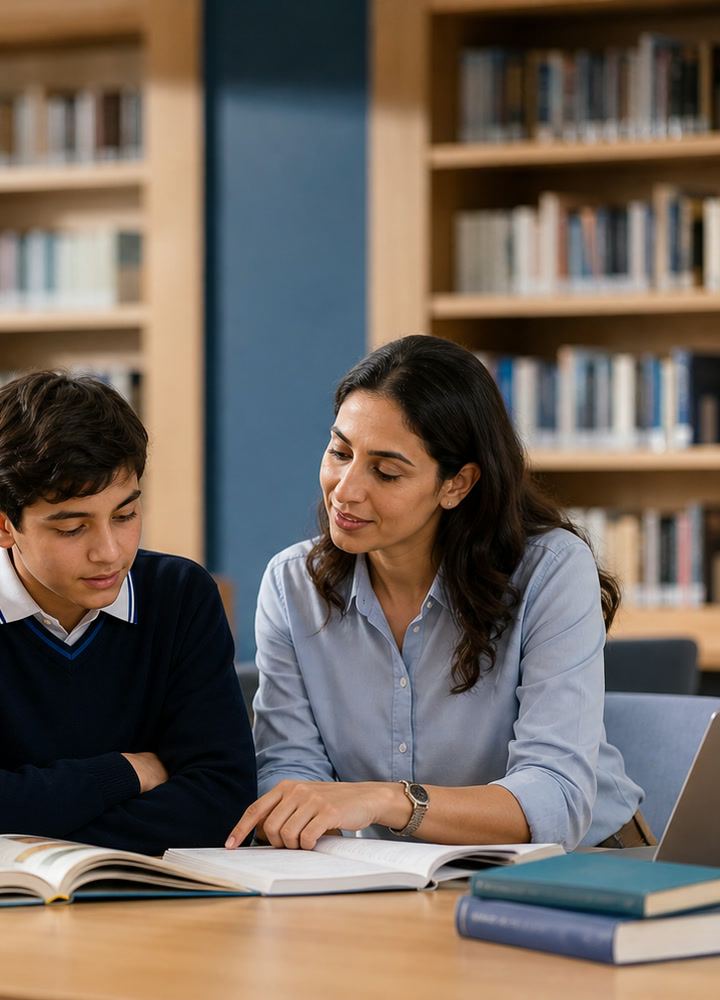
Knowledge & conceptual understanding
Students build secure subject knowledge and conceptual understanding so they can recognise patterns, relationships and significant ideas.
Curriculum
The SIS curriculum is designed to develop the whole child. Academic knowledge remains essential, but education at SIS goes beyond the acquisition of facts.

What we place importance on
Students develop strong foundations within individual subjects while also learning to make connections between different areas of knowledge.
Students build secure subject knowledge and conceptual understanding so they can recognise patterns, relationships and significant ideas.
Students learn to express ideas, listen to others, investigate information and communicate their findings with clarity and confidence.
Learners question, analyse, imagine, solve problems and explore more than one way to approach a challenge.
Students work purposefully with others while learning to organise themselves, reflect on progress and become increasingly independent.
Programme of Inquiry
Stanley's Programme of Inquiry maps a broad, balanced and connected learning journey from KG1 to Grade 5. It shows how each year group explores significant ideas through the six transdisciplinary themes.
Subject areas
Our subject areas give students the knowledge and skills to communicate clearly, reason carefully, create confidently and understand the world around them. Kurdish, Arabic and Religious Education remain important parts of the national curriculum, students’ education and cultural identity.
Students develop their ability to read, write, speak, listen, view and communicate effectively. Through language, they express ideas, understand others, investigate information and participate confidently in their communities.
Students explore numbers, patterns, measurement, shape, data and mathematical relationships. They develop fluency, accuracy and confidence while learning to explain their reasoning and apply mathematics to real situations. The emphasis is not simply on finding the correct answer, but on understanding how and why mathematics works.
Students observe, question, investigate, experiment and use evidence to develop explanations about the natural and physical world. They learn to think scientifically, test ideas and communicate conclusions. Science also helps students consider relationships between people, technology and the environment.
Students explore people, communities, cultures, places, systems and relationships. They deepen their understanding of their own society and heritage while considering different perspectives and an interconnected world.
The arts give students opportunities to create, perform, respond and communicate through visual art, music, drama and other forms of expression. Students develop imagination, confidence, cultural understanding and the ability to express ideas in different ways.
Students develop their understanding of health, well-being, relationships, identity, movement and physical development. They learn to make informed choices, work with others and develop positive habits. This area supports the whole child physically, socially and emotionally.
Students use digital tools to investigate ideas, organise information, create, communicate and solve problems. Technology is used purposefully to extend learning and support responsible participation in a connected world.
Kurdish language learning develops strong reading, writing, speaking and listening skills. It also deepens students' connection to local language, culture, literature and heritage.
Students develop their ability to read, write, speak and understand Arabic. They explore the richness of the language and its cultural and literary traditions. Arabic learning strengthens communication, identity and connection within the wider community.
Religious Education supports students in understanding beliefs, values, ethics and traditions as part of the national curriculum. It encourages thoughtful reflection, respectful discussion and responsible behaviour.
IB Primary Years Programme
An international curriculum framework for children aged 3–12.
Stanley International School is a Candidate School* for the Primary Years Programme (PYP). This school is pursuing authorization as an IB World School. These are schools that share a common philosophy—a commitment to high quality, challenging, international education that Stanley International School believes is important for our students.
The PYP places the learner at the centre of the educational experience and emphasises inquiry, conceptual understanding, student agency, international-mindedness and meaningful action.
Rather than viewing learning simply as a collection of separate subjects, the PYP encourages students to recognise connections between different areas of knowledge and the world around them.
*Only schools authorized by the IB Organization can offer any of its four academic programmes: the Primary Years Programme (PYP), the Middle Years Programme (MYP), the Diploma Programme, or the Career-related Programme (CP). Candidate status gives no guarantee that authorization will be granted. For further information about the IB and its programmes, visit www.ibo.org.
How the PYP works
Students continue to develop important subject-specific knowledge and skills, but they also learn to make connections across and beyond traditional subject boundaries.
A question about water can draw on several areas of learning at the same time.
Understand its properties.
Measure and compare consumption.
Investigate access to water.
Research and communicate findings.
Collect, organise and present information.
Consider responsibility and choices.
Six transdisciplinary themes
The PYP organises significant learning through broad themes that help students investigate ideas important to people everywhere while connecting different subjects.
Identity, beliefs, values, relationships, health and what it means to be human.
Personal histories, journeys, discoveries, migration and relationships between people, places and time.
The ways people discover and express ideas, feelings, culture, beliefs, values and creativity.
The natural world, scientific principles, technology and interactions between people and their environment.
Human-made systems, communities, organisations, decision-making and the ways societies function.
Rights and responsibilities, access to resources, sustainability, peace and our shared responsibility for the planet.
Explore inquiry, student agency, international-mindedness and our From Thinking to Making philosophy.